E is for Eighteen Crossroads

2 Comments

This one was a given. My A-Z Challenge theme is my work in progress, and Eighteen Crossroads is the title of that work.

Easy-peasy.

Why eighteen? Because there are eighteen MCs: Aniela and her husband Josef, eight of their children, and eight of their grandchildren. Nearly all of the stories are told in the first person. (There’s a reason for this—but man, it’s a challenge!)

Why crossroads? Because each story is about a “crossroads moment” in the life of its MC. We all have such moments. Sometimes we have a choice, and sometimes the choice is made for us. If you read yesterday’s post, see if you can figure out Daphne’s. Is a choice made for her, or does she make a choice herself?

Some of the crossroads intersect quite obviously with those of other characters, as Daphne’s does with her mom’s. But in most cases, they’re more subtle than that.

In the book’s original conception, all of the MCs were also going to be eighteen themselves—I mean, eighteen years old—because eighteen is a time when many of us find ourselves at a crossroads of some kind. But then a couple of characters wound up just remembering events that occurred when they were eighteen, and others found themselves at crossroads that had nothing to do with being eighteen at all.

And I realized two things: 1) Not all of our most significant crossroads moments occur at eighteen (in fact, one of the biggest such moments in my own life came when I was 42), and 2) Just because you’re a writer, that doesn’t mean you have total control over your work or the characters that populate it.

But anyway, there you have it— Eighteen Crossroads.

D is for Daphne

4 Comments

[Post removed]


C is for Chrusti

8 Comments

My maternal grandmother, Apolonia (Pauline) Bobrowski Urynowicz, came to the United States in July of 1907, just like Aniela. In fact, she’s the inspiration for Aniela, and thus for my entire book, which is a composite novel.  In a way, I’m writing it in her memory, even though the book itself is fictional.

A composite novel is generally comprised of a series of interrelated short texts that may or may not be limited to short stories. In my case, the book will also contain other texts, including a few of her recipes.  I can think of no better way to keep her memory alive.

One of my favorites has always been her recipe for what my mom always just called crullers. In Poland, depending on the region, they’re called faworki, chrusty, or chrusciki, and in the United States, they’re generally known as bow ties or angel wings.

But my grandmother called them chrusti (with an i), so to me, chrusti they are. It’s pronounced HROO-stee. (The singular, chrust, is pronounced HROOST.) They look like this:

(I wasn’t able to find any pictures of my own, so these will have to do).

I’ve seen many, many recipes for these, both online and in hard-copy Polish cookbooks, but although the final product looks the same, none of the recipes is the same as my grandma’s. I have no idea what quality the results of any of those others might produce, either, but no matter what they look like, I’m very sure they can’t possibly taste any better than hers.

Here’s a picture of my grandma’s much-loved and well-worn recipe, which I wrote down in haste while actually making them with her in the winter of 1976, the year before she passed away:
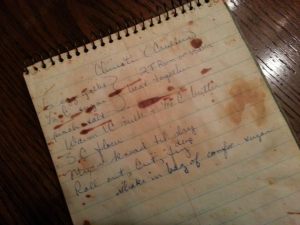
CHRUSTI RECIPE PHOTO 1

As far as I know, it’s the only written-down version of her recipe in existence.

And that’s the thing, right? One of the primary purposes of the whole novel, even though it is a novel and not a memoir, is to draw attention to the way memories form, the way we hold our ancestors close though whatever historical connections we can find.  Not just me, but all of us.  And one of those is always, or should always be, the ritualistic preparation of traditional foods.

So here, in the spirit of keeping her memory alive, is my grandma’s recipe in full. If you choose to make it a part of your own family’s tradition, I ask only that you keep her name attached to it.

Grandma Pauline’s Chrusti

Ingredients:

1 cup milk

½ stick (1/4 cup) butter

6 egg yolks

½ cup sugar

pinch salt

2 T vodka or rum (vodka is traditional—we use rum)

3 cups flour

confectioner’s (powdered) sugar

oil for deep frying


Procedure:

Warm milk and butter just until bubbles form around the edge of the pan (do not allow to boil). Remove from the heat and allow to cool until the pan is comfortably warm to the touch.

While milk is cooling, beat the egg yolks with the sugar and salt until thick and lemon yellow. Stir in liquor of choice.

Add half of the warm milk mixture to the egg yolk mixture in a steady stream, stirring constantly.

Mix in half of the flour, then the rest of the milk, then the rest of the flour.

Knead until the dough no longer sticks to your hands. (A little additional flour may be necessary, but don’t add too much.)

Roll out the dough very thin, about 1/8 of an inch thick, on a floured board. Use a pizza wheel to slice the dough into strips about 3” long by 1 ½ inches wide (measurements do not have to be exact).

Make an inch-long (or so) slit lengthwise in the center of each piece, and pull one end through the slit.

Deep fry, a few at a time, in hot oil (375 degrees). Drain on paper towels. Sift powdered sugar over them, or shake a few at a time in a paper bag of powdered sugar, while still warm.

These get stale very, very quickly. Best to make them when you have a lot of people around.

Makes around eight dozen.

Great with coffee or tea.

B is for Bedczynski

6 Comments

I’ve always been interested in and proud of my Polish heritage. When I got my first car when I was seventeen, I put a Polish coat of arms sticker on the back windshield.  A stylized eagle hovering over the ramparts of a castle.  I loved it.

Jump forward a few decades. In one of the very first stories I wrote for this book, long before I even knew it was going to become part of an actual book, the main character’s name was Catherine Bedford. Her name came to me out of nowhere, and I knew, as soon as it popped into my mind, that this was her name. There would be no changing it.

When I realized her Polish parents needed a Polish name from which Bedford might have derived, Bedczynski popped into my head. It wasn’t a name I’d ever heard in my life, but again, I knew, as soon as I thought of it, that this was the family’s name.

Of course I promptly did a search for the surname Bedczynski.   Now, remember, this name was totally invented. It’s MY name, in a way. I made it up out of thin air. So I wasn’t surprised when my search turned up no hits. In a way, I was relieved, and I gave it no further thought.

But last summer as I was working on another story, I needed a name of a town for another character to be from, and it was in this search, on a page of maps of Poland in 1907, that I unexpectedly found a listing for Będziński .

I invented the dang name and spelled it wrong? What?

So I clicked on it . . . and found that it’s a region (not a name, per se)—and the page that came up showed not a map, but a coat of arms for that region. My heart stopped when I saw it.

The coat of arms is the same one I had on the Poland sticker on my first car. I put that sticker on the car in about 1976. I remember it vividly. And now I find out it’s the freaking coat of arms for Będziński.  Creeeeepy!!!

BEDCZYNSKI COAT OF ARMS

But wait—it gets even trippier.

The coat of arms page contained a list of towns that have coats of arms, with live links for each.  One of them was a place called Bobrowniki.

Really? Really?? Bobrowski was my grandmother’s maiden name.

Of course I clicked on it. And guess what? Bobrowniki is a township in Będziński .

Goosebumps. It still gives me goosebumps.

I’m telling you–this book was meant to be.

_______________

Coat of arms image by Bastianow (vector version) [Public domain or <a href=”http://creativecommons.org/licenses/by-sa/2.5″>CC-BY-SA-2.5</a>%5D, <a href=”http://commons.wikimedia.org/wiki/File%3APOL_powiat_b%C4%99dzi%C5%84ski_COA.svg”>via Wikimedia Commons</a>

A is for Aniela

4 Comments

I wavered between two possible themes for the A-Z Challenge, but after deciding there were plenty of grammar gurus out there already, I’ve chosen to blog about my work in progress, a composite novel titled Eighteen Crossroads.  

It’s kismet that Aniela’s name begins with A, since her story establishes the foundation of the whole cycle. Her spirit resides in nearly all of the characters who populate the rest of the stories in the collection, so it seems right to begin the Challenge with her.

Her story begins with her arrival in America in July of 1907. She’s eighteen—spunky, spirited, confident, and capable.

Since Poland was divided (or “partitioned”) in 1795, the area she hails from (Kowno) belongs to Russia.  This means she’s legally Russian, but she’s ethnically Polish. (Nobody in the United States who claims Polish roots is really Polish if they or their ancestors came to America between 1795 and 1918, since politically, Poland didn’t exist at all during that period.)

Like most other ethnic Poles of the time, Aniela is concerned with the perpetuation of a Polish national identity in the absence of a physical country to call her homeland. She doesn’t want to be American—she wants to be Polish in America, since it’s illegal to be Polish at home. America is the land of the free, she reasons, and therefore she should be free to be Polish if she wants to. But her desire to cling to her Polish identity conflicts with the American societal expectation that first-generation immigrants jump into the Melting Pot.

The whole cycle explores this challenge: the development of an American identity made up of other national identities belonging to immigrants who don’t necessarily have any desire to abandon them. The collection tells the stories of three generations as they variously embrace and reject Aniela’s version of the American dream.

What is an American, anyway? Is one American because one has settled here and is raising a family here? Or is American identity involved with something more?

A-Z CHALLENGE!

10 Comments

I’ve finally done it—I’ve lost my mind.

You haven’t heard from me in months—not since the bleach debacle—and now, here I am, committing to writing and posting every single day for a whole month!

But the A-Z Challenge just looked like too much fun to pass up.

Here are the basics:

Participants will post every day (except Sundays) for the entire month of April. Each day’s post will correspond to a letter of the alphabet. It all starts tomorrow (well, now today—April 1) with the letter A, and it’ll finish up on Wednesday, April 30, with the letter Z.

Brief posts. Engaging posts. Useful posts.

Well, that’s how I’m envisioning it, anyway.

Are you ready for this?

Am I?

Fun Times in Hagenson Land

9 Comments

Laugh or cry?  You be the judge.

Tom decided this morning that the kitchen sink was dirty.  Me, when I make that judgment, I just get out the cleanser, you know, and do a bit of scrubbing.  Not Tom.  He plugged up both sides of the sink, got out the Clorox, poured a good quart of it into each side, and turned on the hot water.  While the first side was filling, we had a little debate about the benefits of cleanser, and then he switched the faucet to the other side, and I shrugged (what woman complains when her husband wants to clean something?), went upstairs to escape the bleach smell, and forgot about it.

Ahh . . anyone who knows Tom is well-acquainted with his colorful vocabulary.  Twenty minutes later a stream of invective you can only begin to imagine invaded my peace.

“What?”  I yelled downstairs.

“Um, a little help here?” he hollered.

I went downstairs.  The smell of bleach was overpowering.  That might be because it was in the dining room.  And the living room.  And everywhere in between.  Yep–the bleach-infused water had made its way across the hardwood and out both kitchen doors in its quest for freedom.

The knife drawer was full of water.  The cabinet under the sink, ditto.  The recycling bin, ditto.

I quickly assessed the situation.  “Did you forget to turn off the water?”

I confess, it was hard not to laugh–but I knew he’d have trouble finding any humor in the situation.

Tom predictably responded with several words containing the letter F.

Wait.  It gets better.

Tom is usually a great one for solving problems, but in the same way that his solution to the dirty sink problem differed from mine, his solution to the flooded-house problem was not to get the mop (oh no, not the mop, which is what I would have done) but to take every single towel from both main-floor bathroom cabinets and fling them, many not even unfolded, onto the floor to soak it all up. By the time I got downstairs, he had already achieved a colorful patchwork of towels from the dining room through the kitchen and into the living room.

One rule every housewife knows, a rule that Tom had chosen to ignore, is that one never, ever uses bleach when washing towels.  You wind up with varying degrees of fade and tie-dye.  All of our towels have now suffered this fate.  He swears they’re fine.  As I’m the one who put them in the washer, I know they’re not.

On the good side, you could do surgery on our floors if you wanted to.  Not a germ in sight.  But my eyes are still watering.  Whether it’s from laughing, crying, or bleach, I’m not sure.

Fun times in Hagenson Land today!

Pot Luck: In a Jam

2 Comments

With my birthday coming up later this week, my family has been hounding me for a wish list.  I dutifully got out a sheet of paper, but then I merely stared at it while my mind and the paper both remained entirely blank.

Problem is, I really can’t think of anything to put on it.  I have everything I want, and everything I need, already.  I confess—I’m one of those people who are hard to buy for.

Several years ago, I came up with a brilliant solution:  I asked for a tree.

My husband thought I was nuts.

“We live in the woods, and you want a tree for your birthday?”

“Yes,” I said.  “I want a weeping willow.  We had one when I was a little girl, and I always loved it.”

They got me one.

The next year, for Mother’s Day, they got me another.

And for my birthday that year, they got yet another.

Over time, I wound up with six.  At that point, my husband said “No more willow trees!”

So then I started asking for fruit trees, because when I was a little girl, we had a yard full of fruit trees, including figs and persimmons and plums.  If you’ve never had a fresh fig or a persimmon, you don’t know what you’re missing.  And my mom’s Polish plum jam was to die for.

I can’t grow persimmons or figs in Wisconsin, but I can grow plums.  So I asked for a plum tree.

My kids cheerfully complied with my request.

Over the course of the next few years, we planted not just the one plum tree, but two (I needed a second variety as a cultivar), and also two pears, two apples, and two cherries.  I spaced them carefully along the driveway, and although they haven’t all survived, the ones that have look very pretty.  Unfortunately, they’ve never produced much of anything.

Until this year.

This year the trees all seem to have decided to make up for lost time.  In fact, I wondered if they were having a competition.  We got a good dozen-and-a-half each of pears and apples, and a whole tree full of cherries (though the birds got to them before we picked a single one—next year I’m gonna buy a net.)

But if it was a competition, the plum tree won.

You have to understand, this is a teeny tiny tree.  It was only planted maybe three years ago.  But this year it managed to produce an easy fifty pounds of fruit.  That’s not fifty plums—that’s fifty pounds of plums.  The branches were hanging clear down to the ground.

My “About me” page says I can’t grow much of anything, and that’s really no lie.  But apparently I can grow plums.  Oh boy, can I grow plums.

And although plums were actually never on my list of favorites when I was a little girl, or not when it came to fresh eating, I can still taste my mom’s jam.  Man, she made some great jam.

So with my fifty pounds of plums, I decided I would make jam.

Problem is, I don’t actually know how to make jam.  I’ve never done it before.  And I don’t have my mom’s recipe, which was conveniently stored in her head but was apparently never written down.  So I went online in search of a recipe that sounded like what my mom used to make.

And what did I find?  Polish plum jam.  Powidła śliwkowe.  As soon as I saw it, I was certain that was what my mom used to make.

So as I write this, that’s what I’ve been doing:  making Polish plum jam like my mom used to make.  Or anyway, I hope it’ll be like hers.

But while it’s cooking, I still have a birthday list to draw up.  We’ve really about run out of space for trees, but maybe I could squeeze in one more.

Do I dare to plant a peach?

Shifting into Low Gear

4 Comments

A new semester is getting ready to begin.  In fact, for many, it’s already begun.   But where I work, the first day of classes is next Thursday, September 5, and since all of my classes this fall meet  Monday, Wednesday, and Friday, the semester will begin for me on Friday.

It might seem odd, starting a semester at the end of the week, but I actually like it.  It gives me a chance to get all of the introductory material done and out of the way on that first day, let everyone enjoy the weekend, and then hit the ground running the following Monday.

That’s my plan.  Hit the ground running.  And we’ll run, more or less nonstop, until the semester ends on December 20.

You may be wondering, what does this mean for the blog?

It means that starting next week, it’ll be shifting into low gear, and I’ll be posting once a week instead of three times a week.  Tuesday will be Blog Day, and the monthly schedule will look like this:

1st Tuesday of the month (starting Sept 3):  WIP

2nd Tuesday:  GUMP/College Writing

3rd Tuesday:  Pot Luck

4th Tuesday:  Bookshelf.  (Ooh, a new category!)

5th Tuesday:  Not sure yet.  There are only three 5th Tuesdays coming up in the next few months (October 29, December 31, and April 29), so I’ll try to make them worth looking forward to.

Hope you enjoy the last few days of summer!

Are you happy to see summer end, or are you dreading it?

WIP: Why I’m Writing this Book

2 Comments

Someone asked me why I’m writing this book, and whether it’s a biography of my family.

There’s an easy answer to the second half:  No.

But it’s actually more complicated than that.  It’s true that I was inspired, and the book is inspired, by my mom’s family.  But it’s not a biography, nor is it a memoir.

I started with what my mom’s family started with:  Two young Polish immigrants coming to America in 1907.  The young woman comes in July; the young man, in November.  They’re both from the same part of Poland (the Russian partition), but from different towns; they don’t meet until after they arrive in America.  They marry in June of 1909 in New Jersey, where he works as a boilermaker for the railroad, and they have a couple of children.  Within a few years, he’s transferred to Jackson, Michigan; they live in a small bungalow in town and have several more children, and then in 1926, they move to a farm on the outskirts of town.

This much is all historically accurate.  My maternal grandparents did all of these things, and in these time frames.

But from that starting point, nearly everything in Eighteen Crossroads is entirely fictional.  Josef and Aniela don’t have the same number of children as my grandparents, nor the same configurations of children (x-many boys, x-many girls, born in x-years).  None of the second- or third-generation characters in the book are real people, and even where some version of some of the events in these stories did actually take place, those events have been fictionalized.  In most cases, they didn’t really happen, and in cases where they did happen, they didn’t happen to these people in these places.

For instance, one of my uncles did serve in Patton’s Third Army during WW2, and I’ve been told he fought at the Battle of the Bulge (a time and place in which one of my stories is set), but I know no more about my uncle’s service (or his life) than that.  I’m sure none of the events in the story in which the main character finds himself in those basic circumstances are remotely similar to the actual events of my uncle’s life.  It would be an incredible (and unlikely) coincidence if they were.

Similarly, I know my grandfather was conscripted into the Russian army, and that he was injured in battle due to a fall from a horse—but I don’t know when or where, or even in what conflict, he fought.  He did die as a result of his refusal to allow the amputation of his leg due to gangrene, and he did say that he came into this world with two legs and he was jolly well going to go out with two legs (actually I think the “jolly well” was probably tacked on by my mom), and my character Josef in the novel does all of these things.  But the fictional character isn’t my grandfather, and the story is not my grandfather’s story.  The fictional Josef is a different Josef altogether.

The point is, this novel is a work of fiction, and the characters who populate it are also fictional.

I am not writing it to tell my own Polish immigrant family’s story.  But I am writing it to tell a Polish immigrant family’s story.

Which leads me to the other half of my friend’s question:  Why am I writing this book?

My purpose is to explore issues of both human identity (removed from national identity and/or language and custom) and the formation of American identity as it develops over several generations.  I’m fascinated by the well-known “generation gaps” that seem so inevitable between parents, their children, and their grandchildren, even as the human condition–that is, the general experiences involved in simply being human–remain unchanging from one generation to the next and also across races, creeds, and cultures.  Why is it so hard for most of us to imagine our parents as eighteen-year-olds, or as children?  What defines family, other than genetics?

In the book, Aniela struggles with the difference between the American “Melting Pot” and what Poles referred to as “Russification” in the 19th and early 20th centuries, which was enforced by law.  There’s also a marked contrast between Poland and America, both politically and socially, as America was a country in need of people and in search of an identity, while Poland at that time (or more accurately, Polonia) was comprised of millions of people in the diaspora who identified as Poles but had no country to call home.

And finally, two or three or four generations removed from the immigrants themselves, do the American descendants of those immigrants have any connection at all to their ancestors’ roots?  — and should they?

The exploration of these questions, and others, is the reason I’m writing this novel.

And also . . well . . it’s fun.

Why do you write what you write?  What inspires you?

Older Entries Newer Entries

Evelyne Holingue

Chronicles, Stories & Books by a French-American Writer

bemuzin

Musings and Amusings

~Plucking Of My Heartstrings~

Blogging on a variety of things that pluck at the hearts' emotions & more

Making Life an Art

Finding the miraculous in the mundane

Raising the Curtain

A look at life at the crossroads in preparation of the second act...because life does not come with signage

Holly Lisle: Writer

needles hopscotching through haystacks of truth

No Roads Lead to Rome

needles hopscotching through haystacks of truth

Grammarly Blog

needles hopscotching through haystacks of truth

The Creative Penn

needles hopscotching through haystacks of truth

BookBaby Blog

needles hopscotching through haystacks of truth

Writerswrite's Weblog

Just another WordPress.com weblog